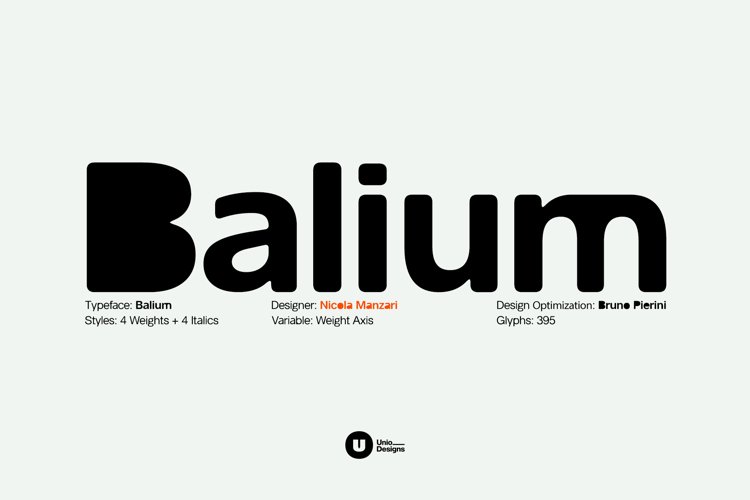
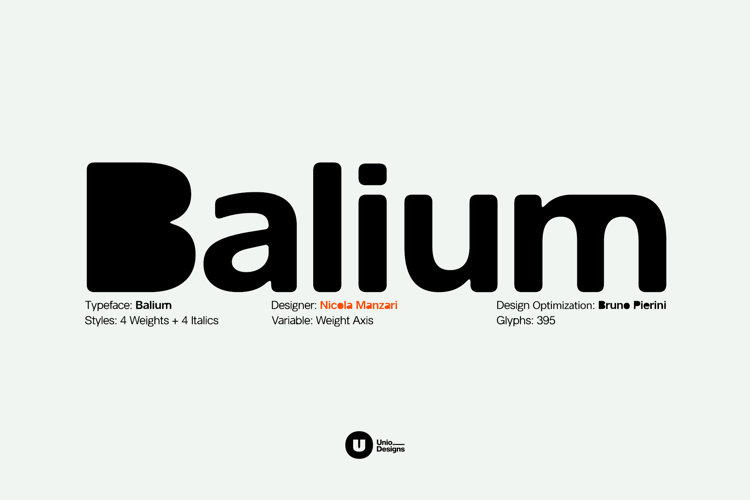
Balium is a contemporary sans-serif type system born from the deliberate reinterpretation of printing errors and the traditional strategies used to conceal them. Conceived as a variable family and designed entirely from scratch, Balium treats error as an intentional latent flaw: all areas that would conventionally require stroke thinning are instead saturated with black. This choice produces a recurring, irregular visual language that oscillates between solidity and distortion, introducing expressive noise into a visual culture increasingly shaped by algorithmic precision and AI.
The name Balium derives from the Latin balium, associated with the act of “abbagliare”—to dazzle, to overwhelm with glare or brightness. This notion of glare and visual excess directly informs the typeface’s constructive approach: forms are not refined by subtraction, but built through accumulation, where excess material becomes structure and error turns into a generative principle.
The family spans from Roman to Extra Bold through a continuous, proportionally stable interpolation between two primary masters. Along the weight axis, Balium progressively intensifies its anomalies, exploring imperfection through normal and filled styles, deliberately disrupted kerning, and a consistent pairing with its italic counterpart. Each style preserves overall rhythm while amplifying error within the typographic system.
Balium is conceived as a versatile yet explicitly experimental voice, capable of shifting from headline to interface without losing its character. It is a typeface designed for brands and designers who embrace controlled imperfection, operating at the intersection of contemporary typography, technology, and visual experimentation.
Typeface Specifications:
- Format: Variable .ttf, Static .otf
- Included: Core, Filled, Bad Kerning, Bad Kerning Filled styles
- Weights: Roman, Medium, Bold, Extra Bold including matching oblique
- Global Support: Includes 447 glyphs for a broad range of languages.





 All your Design Needs